Project Implementation Plan: Phases, Steps and Tracking
Learn how to build a project implementation plan with phases, owners, timelines and progress tracking, plus a table of outputs and fixes for common failures.
In a 2025 analysis of 480 infrastructure projects, 43% experienced delays, and the projects took 73% longer on average than originally planned, according to the Infrastructure Transparency Initiative. A deadline on a task list isn't enough to control delivery. A useful project implementation plan identifies what must be ready at each decision point, who can approve it, and how the business will check whether the finished work delivered value.
Phases and Outputs Every Implementation Plan Needs
The share of projects meeting their original goals fell from 72% in 2008 to 62% in 2012, according to PMI's Pulse of the Profession report. That historical finding exposes a distinction project leads need to make: delivering the requested output and achieving the intended outcome aren't necessarily the same thing.
A project implementation plan explains how a team will execute, control, accept, and evaluate the work. It connects scope, resources, responsibilities, dependencies, dates, and risk responses to a business result. The schedule is part of it, not the whole document.
Give Every Phase a Checkable Output
Use the following structure as a starting point. A gate is a decision supported by evidence, not a meeting on the calendar.
Implementation plan phases, outputs and gates
| Phase | Core question | Key output | Typical owner | Exit gate |
|---|---|---|---|---|
| Define success | What outcome must exist? | Success criteria and baseline measures | Project sponsor | Criteria signed off |
| Plan delivery | How will the work be done and when? | Work breakdown structure, schedule, risk register | Project manager | Baseline approved |
| Mobilize team | Who does what? | RACI matrix, workspace and tool setup | Team leads | Kickoff completed |
| Execute | Is the work moving? | Completed tasks, logged hours, deliverables | Task owners | Milestone accepted |
| Monitor and control | Are we on track? | Variance report, change log | Project manager | Variance within thresholds |
| Close and review | Did the project deliver its benefits? | Benefits verification record | Project sponsor | Benefits confirmed against baseline |
The phases aren't a rigid waterfall. Monitoring runs alongside execution, and a rejected milestone may send work back for revision. What matters is that the approver can inspect an output before authorizing the next commitment.
For creative work, design project management provides a useful context for separating exploration from approved production. An accepted design direction should authorize build work; a promising draft shouldn't.
AI projects need the same distinction between demonstration and operational readiness. Ryshe's guide to taking AI prototypes into production is useful when defining what must change before a prototype passes a production gate.
Practical rule: If a phase has no named output, its gate can't be checked.
Keep the evidence proportionate. A small engagement may need a concise approval record rather than a formal presentation. It still needs a named approver, a decision date, and an explicit decision.
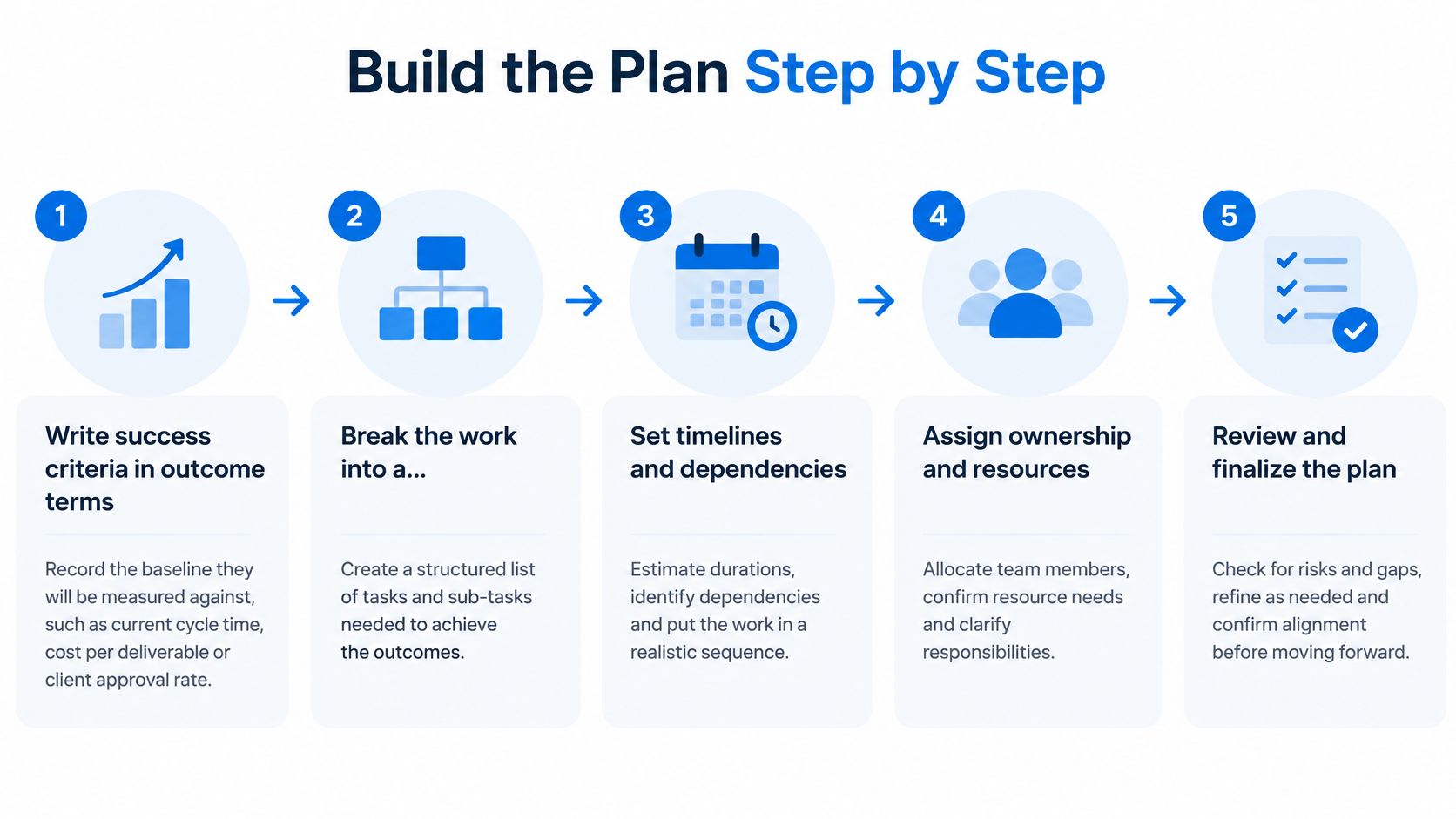
Build the Plan Step by Step
Start with definition, not software configuration. In a study of 73 process-industry projects, the best-performing projects were 18% lower in cost and 8% faster in total cycle time, and the strongest projects had the most complete definition before authorization, according to PMI's published analysis. Those industrial results aren't a forecast for an agency project, but they support doing the hard definition work before committing delivery capacity.
Use this visual as a planning prompt, then turn each decision into an operational record.
Define the Work Before Dating It
Write success criteria in outcome terms.
Replace improve client delivery with a measurable result such as shorten the approval cycle without increasing rework. Record the current measurement, the target condition, the measurement method, and the person responsible for reporting it. The common slip is calling launch the outcome when launch merely makes the outcome possible.Build a deliverable-based work breakdown structure.
Group work under outputs such as approved content, accepted page designs, tested website, and launch handover. Then break those outputs into assignable work packages. Activities such as attend meetings belong underneath a deliverable, not alongside it as equivalent evidence of progress.Estimate effort and duration separately.
Effort describes how much work someone must perform. Duration includes waiting for reviews, supplier responses, and available capacity. Write assumptions beside the estimate, including content readiness, revision boundaries, reviewer availability, and access to systems. Otherwise an estimate becomes an unexplained promise.Map dependencies explicitly.
Identify what each work package needs before it can start and what its completion enables. Distinguish genuine dependencies from convenient sequencing. Copywriting and image production may run in parallel, while development of an approved page layout requires design acceptance first.
Don't purchase tools before you understand those requirements. If the implementation includes service-management software, the DataLunix guide to Freshservice pricing can inform procurement questions. Record the selected configuration, purchasing owner, and approval dependency rather than treating software acquisition as an incidental expense.
Assign Authority and Protect the Decision Dates
Give each deliverable an accountable owner and each gate an approver.
Contributors can be shared; accountability shouldn't be. A RACI matrix identifies who is responsible, accountable, consulted, and informed. Confirm that the assigned person has capacity as well as the right skills, and establish who can approve when the primary reviewer is unavailable.Set milestones where decisions are required.
Approved homepage design is a milestone. Design underway isn't. Put contingency before the launch gate rather than hiding padding inside every task, and connect each high-risk dependency to a response. A visible buffer lets the sponsor understand the trade-off between scope certainty and launch certainty.Publish the operational plan where the team works.
Keep task descriptions, supporting files, decisions, and time records connected. Don't maintain a presentation schedule that disagrees with the task board. If automation will help maintain the plan, these approaches to using AI for project management can inform the workflow, but a person must still approve commitments.
A task can be assigned without being ready. Its required inputs determine whether work can actually begin.
A walkthrough can help the team discuss the implementation sequence before approving its own plan.
Work Through a Website Launch
Consider a hypothetical six-week client website project. The agency is responsible for content preparation, design, development, review, and launch, while the client retains final approval authority. The dates below are illustrative planning choices, not delivery benchmarks.
| Illustrative timing | Verifiable output | Accountable owner | Gate evidence |
|---|---|---|---|
| End of week 1 | Scope, page inventory, and content responsibilities accepted | Project manager | Client sponsor approval |
| End of week 2 | Client content approved | Client content owner | Approved copy and asset inventory |
| End of week 3 | Homepage and reusable page designs approved | Design lead | Recorded design acceptance |
| End of week 4 | Agreed pages implemented in staging | Development lead | Demonstration against requirements |
| During week 5 | Acceptance testing completed | QA lead | Defects resolved or explicitly accepted |
| During week 6 | Launch authorized and handover completed | Project manager | Launch checklist and client authorization |
Client content approval is the critical dependency. Copywriting and asset production can proceed together, but neither should be treated as approved merely because a file exists. If content approval slips by a week in this scenario, the launch may slip too unless the sponsor accepts a narrower release.
Development of the approved layout has a finish-to-start dependency on design acceptance. Technical setup can happen earlier, but building unapproved layouts creates a deliberate rework risk. If the team chooses that overlap, record who authorized it and which work might be discarded.
Date tasks from their required inputs, not automatically from kickoff. Trace the longest dependent chain through approval, design, development, testing, and launch authorization, allowing for reviewer availability and shared specialists. Confirm that every link has an owner and a date, and that no launch commitment relies on an unconfirmed approval.
Tracking Progress Against the Baseline
Projects that defined success criteria upfront achieved a Global Net Project Success Score of 41 versus 20 when they didn't, according to PMI's project success report. The report also found that projects measuring and continuously tracking performance had success rates nearly twice as high as those lacking those practices. The useful lesson is to measure against an agreed reference, not just report how busy everyone is.
Keep the approved baseline separate from the current forecast. The baseline records the commitment; the forecast shows what the team now expects. Overwriting the original date whenever work slips removes the evidence needed to understand the variance.
Use Triggers That Cause Decisions
The following thresholds are illustrative operating rules, not universal standards or research findings. Agree appropriate triggers with the sponsor before execution.
Progress metrics, check cadence and action triggers
| Metric | What it reveals | Check cadence | Illustrative action trigger |
|---|---|---|---|
| Milestone variance | Days ahead of or behind the baseline date | Weekly | Slip of more than 5 working days goes to the sponsor |
| Task aging | Tasks sitting in the same list too long | Weekly | Any task in progress for 10 working days without an update |
| Hours logged vs estimate | Effort drift on each work package | Every two weeks | Work package over estimate by 15% |
| Open risks | Risk exposure with no owner or response | Weekly | Any high-rated risk without a named response |
| Change requests | Scope movement not yet assessed | Per request | Any change approved without impact analysis |
| Stakeholder acceptance | Whether deliverables meet agreed criteria | At each milestone | Deliverable rejected twice |
A milestone trigger should prompt the project manager to present recovery options, not just turn a cell red. An aging task needs a direct check: is its owner blocked, working elsewhere, or failing to update it? An hours overrun requires a revised estimate to complete before anyone authorizes more effort.
An unowned risk needs an accountable person and a response date. An improperly approved change needs an impact assessment before further work proceeds. Repeated rejection requires the approver and delivery lead to reconcile acceptance criteria, rather than commission another revision without diagnosis.
For budget-controlled work, freispace's earned value formulas for UK projects can support a deeper cost-and-schedule view. Use them only when planned value, completed work, and actual cost are recorded consistently. When evaluating project management scheduling software, prioritize visible dependencies and usable reporting over decorative dashboards.
Control test: Every metric needs an owner, a review cadence, and a corrective action. Otherwise, it's a historical description.
Review tasks and risks weekly, compare forecasts with the baseline monthly, and verify acceptance at each milestone. Keep the dashboard small enough that the project lead can explain every exception and name the person handling it.
Managing Scope Changes and Risks Before They Stall Work
The damaging mistake is accepting a reasonable-sounding request without deciding what it replaces. Project reviews keep surfacing the same failure causes: inadequate requirements, underestimated time and resources, scope changes absorbed without a decision, and risks nobody owned. A technical fix will not resolve a project whose participants disagree about what they authorized.
Change control is not a ban on change. It gives an approver a clear choice about the consequences, and it earns its place only if the routine is short enough that people follow it in practice.
- Log the request. Record the requester, the reason, the affected deliverable, and the decision needed. A chat message can initiate a request. Authorization happens only through the steps below.
- Assess the impact. Check cost, schedule, quality, and the benefit the plan was built to deliver. Include review effort and downstream dependencies, not just production time.
- Get a named decision. The authorized approver accepts, rejects, or defers the request. Group discussion informs the decision; it does not replace accountability.
- Update the controlled records. Preserve the previous baseline, record the approved revision, and notify affected owners the same day.
Treat each approved change as a revised gate. The milestone it touches now has a different expected output, and the benefit the plan promised still has to survive the change.
Turn Risks Into Assigned Responses
Before execution, run a working session with delivery leads and the stakeholders who control approvals or dependencies. Cover scope ambiguity, dependencies, approval availability, missing skills, procurement, data, and adoption. Each material risk needs an owner, a warning sign, a response, and a point at which someone must act.
An entry such as "client may be late" is incomplete. Specify which approval could be late, who will chase it, when escalation occurs, and whether the response is resequencing, reduced scope, or a revised launch date.
- Freeze build requirements. Establish the version authorized for production while keeping a route open for justified changes.
- Review the change log weekly. Include pending and rejected requests with their reasons, so declined scope does not re-enter later.
- Test the riskiest deliverable early. Permissions, migration integrity, and critical user workflows should not wait until launch authorization.
- Revisit active risks. Remove resolved risks and update responses when circumstances change.
AI agents and integrations need operational owners too. The Corporate Governance Institute's discussion of AI governance highlights the problems created when responsibility is split across technical teams, data owners, business leaders, and partners. Before build approval, document who owns each agent's outputs, what it may read or modify, how its actions are audited, and who can pause it.
Require human approval for irreversible actions and test rollback procedures before you need them. A project can hit every milestone and still miss the benefit it was funded for, so include adoption and stakeholder satisfaction in acceptance discussions alongside schedule and budget.
Prove Benefits and Start Your Plan This Week
Closing the delivery board should not close the business question. A finished plan still has to prove the organization got what it paid for.
Give each expected benefit an accountable measurement owner. Separate leading indicators, such as approval requests submitted on time, from lagging indicators, such as a shorter approval cycle. Leading indicators warn you early; lagging indicators confirm the outcome.
Hold reviews at 30, 60, and 90 days after launch. Each review ends in an explicit continue, scale, or stop decision recorded against the target in the benefits register. A benefit that misses its target at three consecutive checkpoints is a candidate for a stop decision, not another quarter of waiting.
Benefits register fields
The values below form a hypothetical approval-workflow example, not a performance promise.
| Field | What to record | Example |
|---|---|---|
| Expected outcome | The business result the project should produce | Shorter client approval cycle |
| Baseline | Measured value before execution | Approval takes 9 working days |
| Target | Threshold that counts as success | Under 5 working days |
| Measurement owner | One named person who reports the metric | Account lead |
| Review date | Scheduled post-launch checkpoint | Day 60 review |
| Stop-or-scale decision | Continue, expand, or shut down based on results | Scale if target is met at two reviews |
Completed content proves output. A shorter approval cycle demonstrates benefit, provided the measurement method stays consistent between baseline and review.
This week, name the sponsor, record the priority outcomes and their baselines, and schedule the initial approval gates. Put tasks, conversations, files, and time records in a shared workspace so the team can inspect the evidence behind each decision.
Tuff brings projects, tasks, chat, documents, files, and time tracking together in shared workspaces. Visit Tuff to set up your next project, keep gate decisions beside the work, and connect delivery records to your benefits review.