Initiatives and Projects: How They Connect and Work
Learn how initiatives and projects differ, how they connect to strategy, and how teams can organize, measure and govern them in 2026.
You're in the weekly standup, and every update sounds fine. The pricing page shipped on time, the onboarding flow is built, the new report is live. Then someone asks the awkward question: did any of it change the number you cared about?
That's the gap between initiatives and projects. A project can finish exactly as planned while the business result it was meant to move stays flat. When you treat each project as a testable bet on an initiative's outcome, that gap becomes visible early, while you can still change course.
What Sets an Initiative Apart from a Project
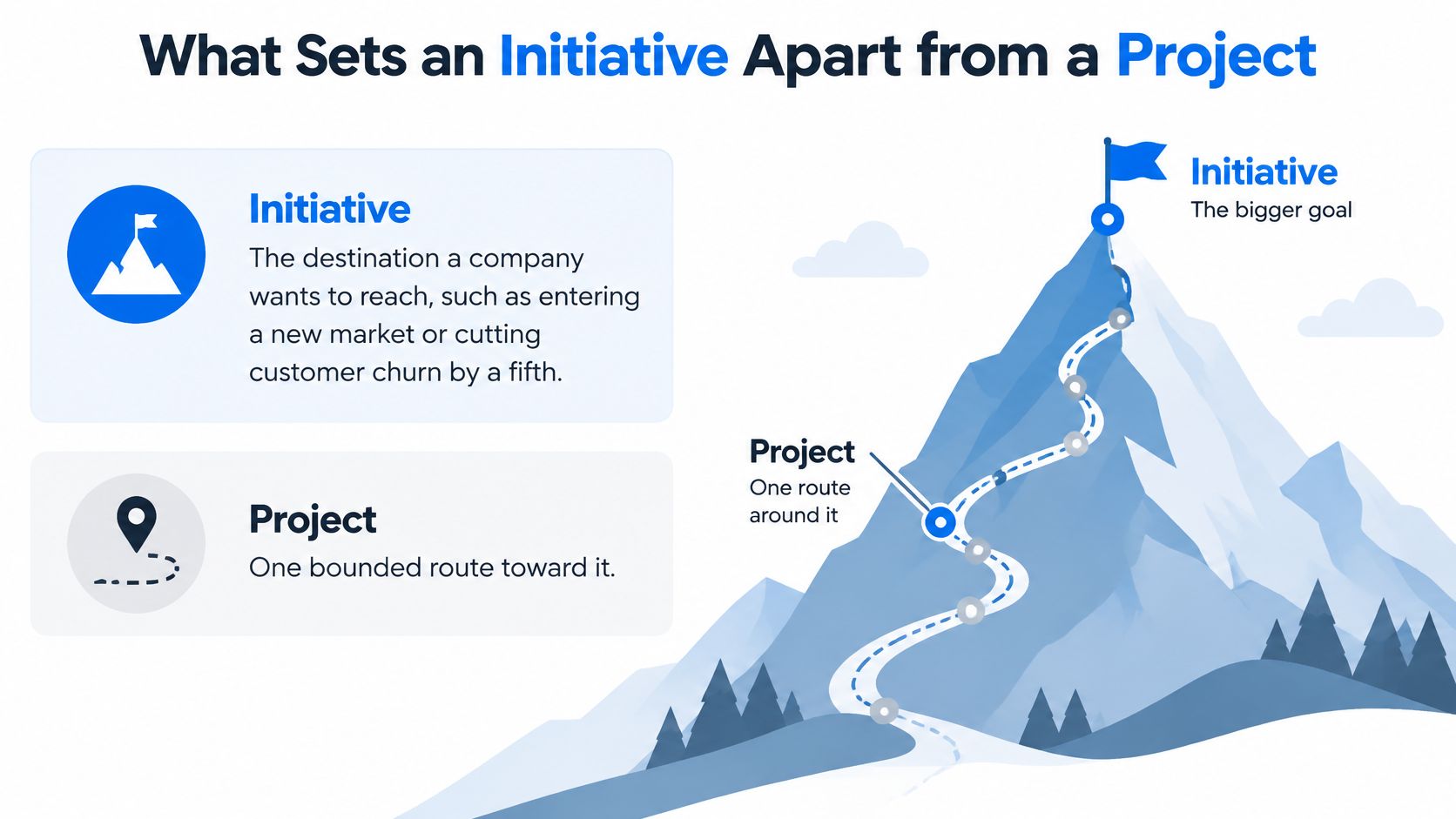
Think of an initiative as the destination and a project as one bounded route toward it. Entering a new market or cutting customer churn by a fifth is a destination. Launching a regional pricing page is one route you might take to get there.
That single image explains most confusion. A team can complete the route and still not reach the destination, because the route was wrong, too small, or aimed at the wrong barrier.
The comparison that carries the answer
| Dimension | Initiative | Project |
|---|---|---|
| Purpose | Achieves a strategic objective | Delivers a defined output |
| Duration | Months to years, often in several phases | Fixed start and end date |
| Success measure | Business outcome and sustained benefits | Scope, schedule and budget met |
| Owner | Executive sponsor or steering group | Project manager |
| Scope | Adjusts as strategy changes | Locked by a charter |
| Ends when | Target benefit is sustained | Deliverable is accepted |
The sentence worth reusing in meetings is simple. Initiatives are judged on outcomes, projects on outputs delivered on time and within budget. An output is a thing you hand over, such as a page, a feature, or a migrated system. An outcome is what changes because that thing exists, such as more qualified buyers or fewer customers leaving.
Confusing the two flatters delivery and hides weak bets. A launch date is easy to celebrate. Proving the launch changed buyer behavior takes a baseline, a target, and a review after the confetti settles.
Why finished does not mean valuable
The Project Management Institute 2024 project success study found that only 48% of completed projects were clearly successful when success was defined as delivering value worth the effort and expense. Another 40% produced mixed evaluations, while 12% were classified as outright failures.
Read that middle group carefully. Those projects achieved some objectives without producing uniformly positive results. In plain terms, work got done, people stayed busy, and stakeholders still argued about whether it was worth it.
Quick test: If it ends when the deliverable is accepted, it's a project. If it ends only when a business result holds, it's an initiative.
Apply that test to your current list. Anything with an acceptance date but no named result belongs under an initiative that supplies the result. Anything described only as a result, with no bounded deliverable or end date, needs projects underneath it before anyone can plan the work.
How Initiatives, Programs and Projects Stack
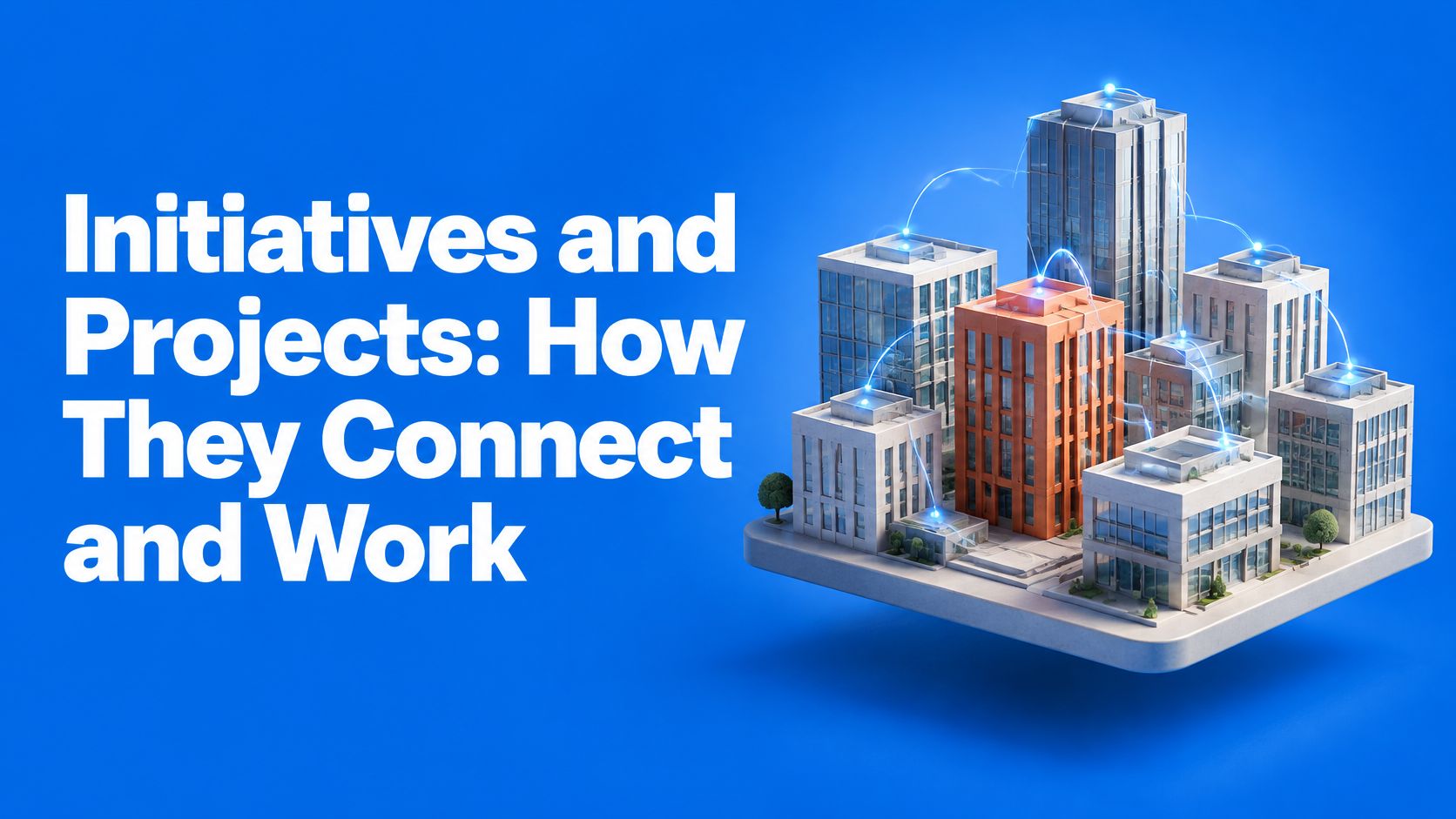
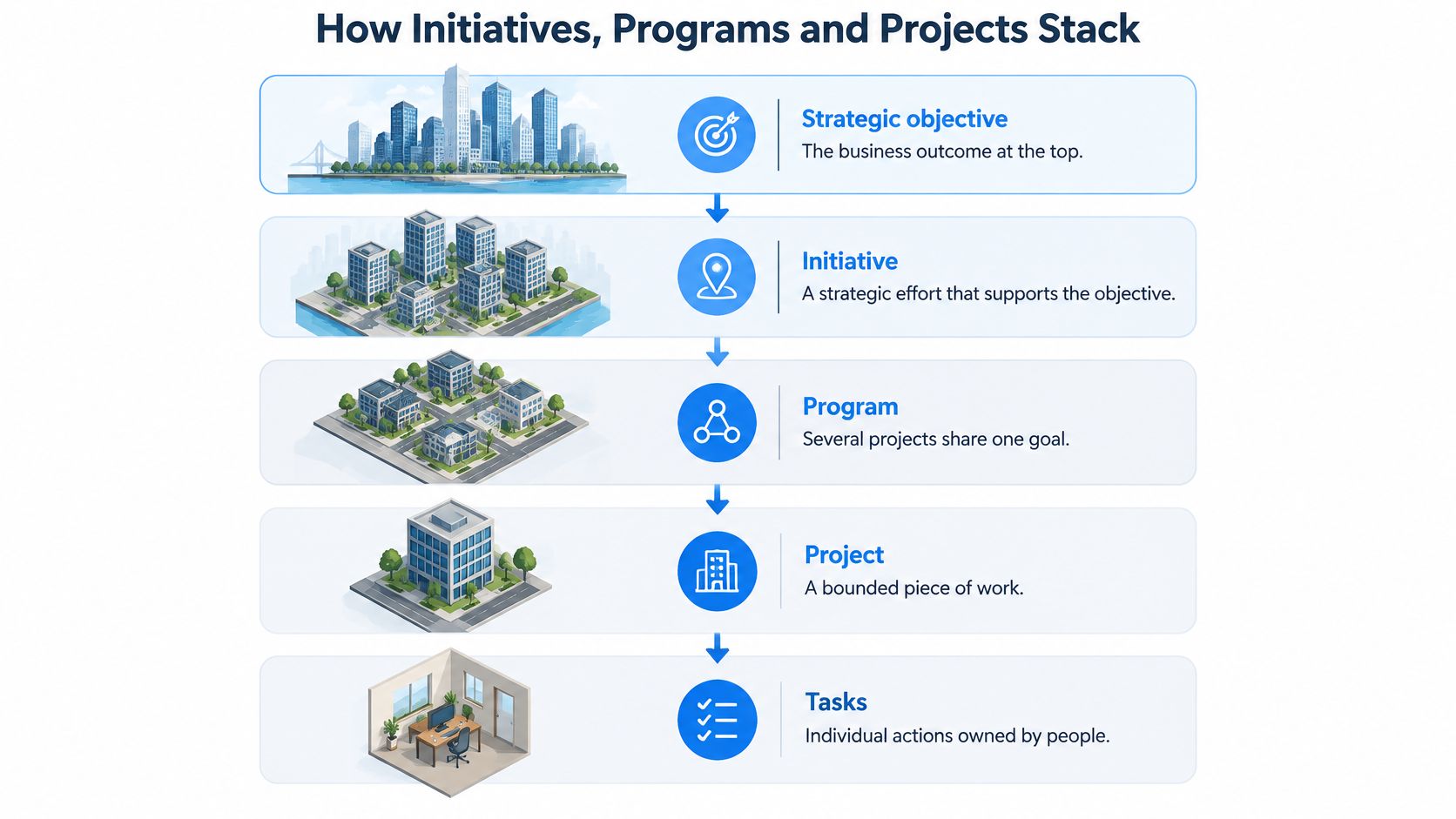
City planning gives you a clean mental model. Strategy is the master plan for the whole city. Initiatives are the districts you choose to develop, projects are the buildings inside each district, and tasks are the trades working inside each building.
The layers stack in a strict order, and each layer has a different owner. Skip a layer and accountability blurs, because nobody can tell who promised what to whom.
Who owns each layer
- Strategic objective: Executives own the outcome and the funding priority, such as growing revenue in a new segment.
- Initiative: A sponsor owns the benefit, such as building a credible presence in that segment.
- Program: A program lead coordinates several projects that share one goal and compete for the same resources.
- Project: A project manager owns scope, schedule, and budget for one bounded deliverable.
- Tasks: Individuals own completion of specific actions with clear finish points.
Programs confuse people most, because not every initiative needs one. Add a program layer only when several projects must be sequenced together, share suppliers or approvals, or would clash without coordination. If you're weighing how shared people and budgets get allocated across those projects, you can explore project resource management for a broader view of that coordination problem.
The PMI report on the high cost of low performance reports that only 56% of strategic initiatives meet their original goals and business intent overall, while high-performing organizations complete 89% of projects successfully versus 36% for low performers. That spread is mostly alignment and traceability, not individual effort.
This short video walks through how the layers relate in practice.
Coordination is the real work
Scale makes the point unmistakable. The Carnegie Mellon account of the Manhattan Project notes that its major activity ran from 1942 to 1945 and employed more than 125,000 direct staff members at its peak. Nobody ran that as a task list. It worked as one interconnected system of people, facilities, budgets, suppliers, and information flows, with explicit ownership at every interface.
Your launch is smaller, but the habit transfers directly. Say a product launch involves a supplier, a legal review, and three regional teams. Map the dependencies before work starts, assign one owner to each interface, and report cost by workstream so a delay in legal review shows up as a launch risk, not a surprise.
The most common break in the stack is a project with no named initiative. The work may be useful, yet nobody can rank it against other demands because it isn't tied to a result anyone owns.
Before approving any project, ask three questions. Which objective does this serve, who owns its benefit, and what would make us stop it? If the room can't answer all three in one sentence each, the project isn't ready to start.
How to Organize Projects Under an Initiative
Start on paper, not in software. If the structure is fuzzy in a one-page document, a tool will only make the fuzziness faster to browse.
Eight steps from charter to working system
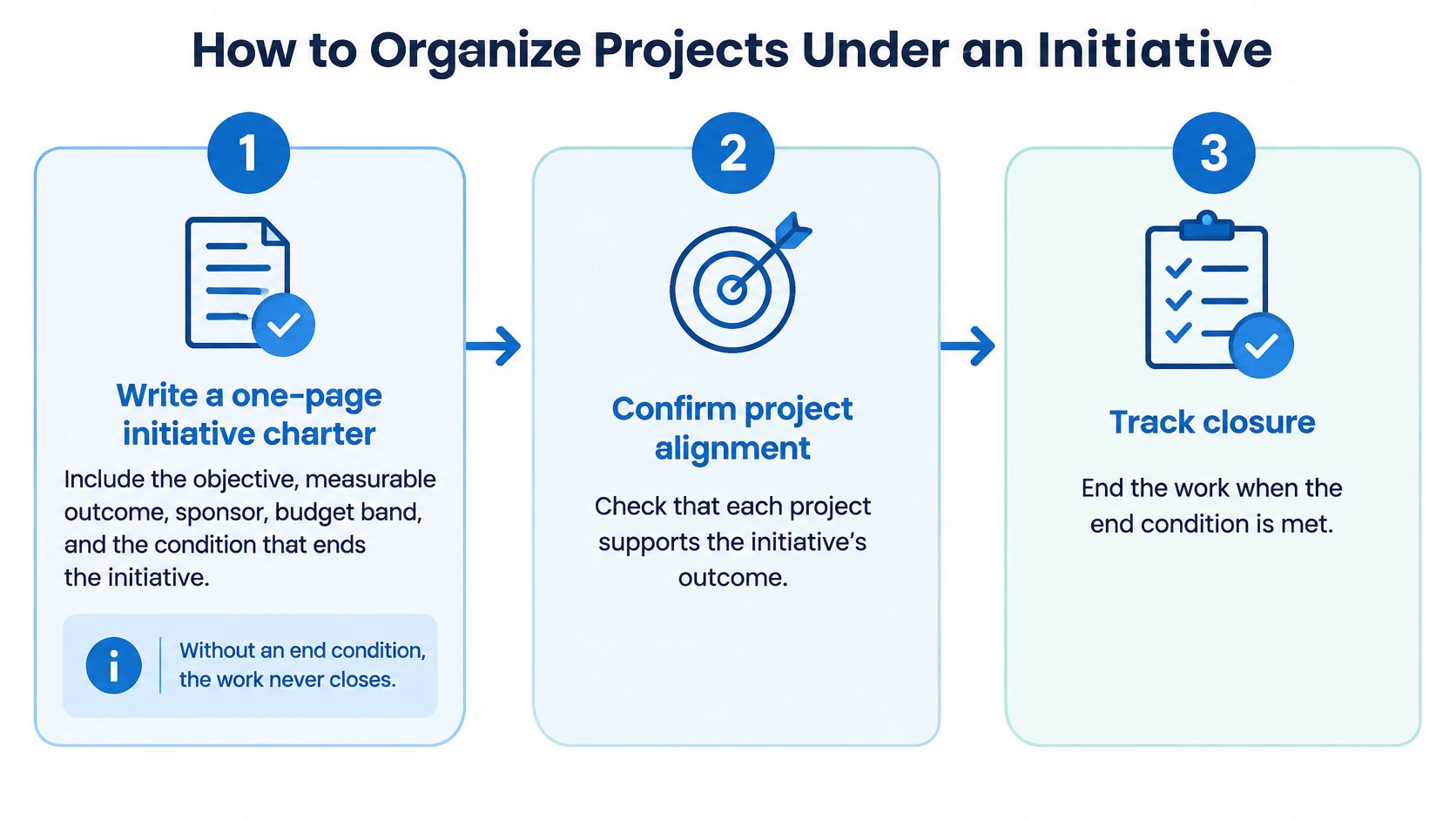
Write a one-page initiative charter. Include the objective, the measurable outcome, the sponsor, a budget band, and the condition that ends the initiative. The common slip is skipping the end condition, which is why so much work never formally closes.
Split the initiative into projects by distinct deliverable or market. Aim for three to seven projects. More than seven usually signals hidden programs that need their own coordination layer, or one initiative carrying two different goals.
Give each project one owner and a reference back to its initiative. Two owners means no owner when a trade-off arrives. The upward reference matters just as much, because it's what lets a reviewer trace any task to the result it serves. When you're ready to turn that structure into a sequenced rollout, a project implementation plan helps you set the order, owners, and checkpoints.
Set the benefit for each project. Name the metric it should move, record the baseline value today, and write the target value you expect. Projects created without a benefit metric are the ones nobody can defend at budget time, however polished the deliverable looks.
Build the task structure inside each project. Use plain lists such as Backlog, Todo, In progress and Done, so status is visible without holding a meeting to discover it. Keep list names identical across projects under the same initiative, because inconsistent labels make portfolio reporting a manual translation job.
Keep decisions, documents, and files inside each project. Reviewers should find evidence without asking for it in chat or hunting through personal drives. Browsing a real Internal Systems project portfolio shows how keeping each body of work self-contained makes it easier for an outsider to understand what was delivered and why.
Agree a review cadence and protect it. Run a weekly task review at project level, a biweekly project-to-initiative review, and a quarterly outcome review with the sponsor. Each cadence answers a different question, so don't merge them into one long status meeting where urgent tasks crowd out benefit questions.
Run a two-week mapping check. Confirm every task maps to a project, every project maps to an initiative, and no orphan work remains. Orphans aren't automatically bad work, but they must either find a home with a named benefit or stop consuming capacity.
What a working setup looks like
A reviewer opening any project can answer four questions in under a minute. Which initiative does this serve, who owns it, what metric should move, and where are the decisions recorded?
If any answer requires interviewing the team, the structure isn't finished yet. Fix the missing piece at the project level first, because initiative-level reporting built on gaps produces confident summaries nobody should trust.
Measuring Whether Projects Deliver Initiative Goals
Measurement works as a control point, not a report you produce after the money is spent. Define expected benefits, owners, baseline measures, target values, and review cadence before execution starts, while changing course is still cheap.
What to measure at each layer
| Layer | What to measure | Example metric | Review cadence |
|---|---|---|---|
| Initiative | Strategic objective reached | Revenue share from the new market | Quarterly |
| Project | Deliverables on time and within budget, and benefit moved | Milestones met against plan, benefit metric against target | Biweekly |
| Task | Work completed and blockers | Tasks closed and hours logged per milestone | Weekly |
Notice the project row carries two measures, not one. Milestones tell you whether delivery is healthy. The benefit metric tells you whether delivery matters. Teams that track only the first discover problems at the quarterly review, when the budget is mostly gone.
Evidence that the discipline pays
In a PMI survey of 717 project professionals, organizations with fully prescribed benefits-realization processes had 61% of projects meet or exceed forecast ROI, compared with 44% where such processes were less mature. Standardized documentation raised the rate from 47% to 56%, while consistently receiving performance information against defined metrics increased it from 47% to 60%.
None of that requires exotic tooling. It requires writing the expected benefit down, in a standard place, and looking at actual performance against it on a schedule. The mechanism is mundane, which is exactly why teams skip it.
The monthly decision
Each month, compare planned benefit against actual benefit for every active project. Flag any project that completes its milestones while its benefit metric hasn't moved, because that's the signature of a finished bet that failed.
Then choose one of three responses, explicitly, in the room:
- Stop: The hypothesis was wrong, and further spending won't fix it.
- Re-scope: The hypothesis may hold, but the deliverable doesn't test it properly.
- Extend: The signal is promising but hasn't had time to mature.
A milestone review that never ends in stop, re-scope, or extend is a ceremony, not a control.
One edge case deserves care. Some benefits lag, such as revenue that arrives two quarters after launch. Don't fly blind in the meantime. Track a leading indicator, such as qualified pipeline or activation rate, until the lagging figure becomes available, and state in advance which leading signal you'll accept as evidence.
Prioritizing Initiatives and Projects Across a Portfolio
Ranking work by activity volume keeps everyone busy and moves nothing in particular. The team that closes the most tasks wins the dashboard, even if those tasks serve the least valuable goal. Rank by expected business value instead.
A scoring method you can run this week
For each active project, estimate three things in plain numbers. Estimate the benefit it moves, your confidence in that estimate, and its cost in effort and money. Then order the list by benefit times confidence divided by cost.
The arithmetic isn't precise, and it doesn't need to be. Its job is forcing hidden assumptions into the open, so a confident small win stops losing to a speculative large one that nobody has examined.
- List every active project and tag the initiative it serves. Unticked projects announce themselves immediately, and you'll usually find more of them than anyone expected.
- Score each project on expected value. Use the benefit, confidence, and cost estimate, and record who made each estimate so you can revisit it later.
- Pause or cut anything with no initiative or a score below your cutoff. Pausing isn't failure. It's how capacity returns to work that can still change a result.
If your list is long and several initiatives run in parallel, the mechanics of managing multiple projects without losing the thread become as important as the ranking itself.
Handling competing demands
Conflicts usually arrive as a people problem. Two projects need the same designer, engineer, or approver in the same week.
Resolve it with the metric, not seniority or volume of complaint. The project that moves its initiative's named metric goes first. The other waits, gets re-scoped to need less of that person, or accepts a later date in writing.
Close the loop with one intake rule and enforce it without exceptions. No new project starts until it names an initiative, a benefit metric, and a baseline. That single gate keeps the portfolio from refilling with orphan work the month after your cleanup.
A Worked Example of Cutting Churn by a Fifth
Say a subscription business wants fewer customers leaving. The initiative charter states the objective plainly: cut annual customer churn from 12% to 9.6%, which is a fifth lower. Those figures are illustrative, but the structure is exactly what a real charter needs.
The sponsor is the VP of customer success, because that role owns retention and can settle trade-offs between support, product, and account management. The charter sets a budget band rather than a false-precision figure. The end condition is churn at or below the target for two consecutive quarters, so one good quarter doesn't close the initiative early.
Three projects, three bets
- Onboarding redesign: The bet is that customers who reach value faster stay longer. The metric is 30-day activation, moving from a 40% baseline to a 55% target, owned by the product lead.
- Cancellation-flow redesign: The bet is that some departing customers can be saved with a better offer or a pause option. The metric is the save rate on cancel attempts, moving from 8% to 15%, owned by the growth lead.
- Proactive account-health alerts: The bet is that early contact rescues accounts drifting toward cancellation. The metric is at-risk accounts contacted within seven days, moving from 20% to 90%, owned by the customer success manager.
Each project tests a different theory about why customers leave. That's deliberate. If all three projects bet on the same cause and that cause turns out wrong, the whole initiative fails together with no alternative explanation to pursue.
Reading the first monthly review
Churn itself only shows up quarterly, which is too slow to steer by. So activation and save rate serve as the monthly signal, with the quarterly churn figure acting as the verdict.
Suppose onboarding milestones are all complete, the new flow looks polished, and activation hasn't moved. That project is finished and its bet has failed, which are two different facts. The right response is to re-scope it, perhaps by interviewing customers who still stall, before funding any new onboarding work.
Now suppose activation rises while the save rate stays flat. Extend the cancellation work instead, because the flat metric may reflect weak offers rather than a wrong theory. Test a pause option against a discount and compare save rates before concluding anything.
The lesson in one line: A finished project with an unmoved metric isn't a success to celebrate. It's evidence about which bet to change next.
Without the initiative-level measure, all three projects could report green for a year while churn sits exactly where it started. With it, the sponsor sees which theory earned more investment and which one needs replacing.
Start with One Initiative This Quarter
Don't reorganize the whole portfolio at once. Pick one initiative with a clear measurable outcome, a named sponsor, and three to five active projects, then run it properly for a quarter.
Three selection criteria
- Measurable within two quarters: You need a verdict while the team still remembers its assumptions.
- A sponsor who attends: The named sponsor shows up to the monthly benefit review and makes stop or re-scope decisions there.
- Existing work to group: Some live projects already fit under it, so you're organizing reality rather than inventing a program from nothing.
From there, follow the setup sequence without improvising. Write the one-page charter, split the initiative into projects, set a benefit metric and baseline for each project, and schedule the first monthly review before new work begins. If you want a guided walkthrough of building that structure in a workspace, this step-by-step tutorial takes you through the mechanics.
The tool matters less than the structure, but a single workspace keeps each project's tasks, documents, and decisions together where reviewers can find them. Tuff is one option for this, with projects, tasks, docs and announcements in one place.
Judge the first month by one verdict. If the benefit metric has moved, the structure is working and deserves a second initiative. If the projects are finished but the metric hasn't, re-scope the initiative before starting any new work, because adding more projects to a failed bet only makes the failure more expensive.
Put your next initiative in one workspace where each project's tasks, docs, chat and announcements stay together, so the monthly benefit review starts from evidence instead of recollection. Tuff combines projects, tasks, chat, docs, announcements, time tracking and AI agents in one app, which makes it straightforward to trace any task back to the outcome it serves. Set up your first initiative with three projects and a baseline for each, and you'll know within a month whether the bets are paying off.